May 6, 2026 · The Big Sip
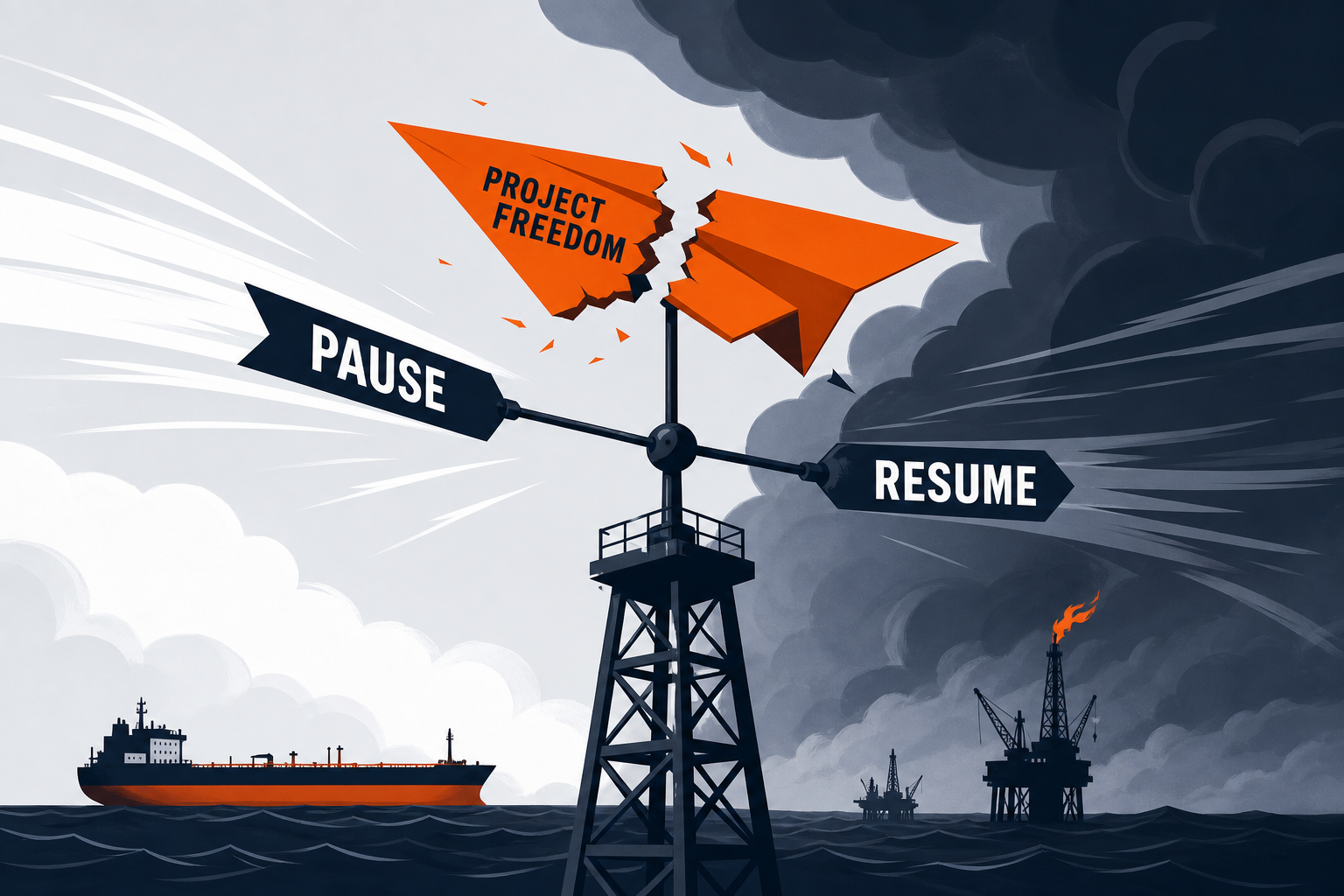
Less than 24 hours after Project Freedom officially launched, President Trump did something almost no oil trader saw coming: he paused it.
In a statement Tuesday evening, Trump said the U.S. military operation to escort stranded commercial vessels out of the Strait of Hormuz would be “paused for a short period of time” because “Great Progress has been made toward a Complete and Final Agreement” with Iran. The pause was made “based on the request” of Pakistan and other countries currently mediating.
The market did exactly what you’d expect a market to do when the most-feared geopolitical headline of the year suddenly downshifts.
Brent crude, which hit a wartime intraday high of $126 on April 30, settled at $108.09 Tuesday (-5.5%) and traded around $106.52 by Wednesday morning. That’s nearly $20 stripped off the peak in under a week — and the steepest 48-hour decline in over a year.
The Catch (and Why Refiners Still Win)
Before you write the obituary on the energy trade, read the fine print: the U.S. naval blockade of Iranian ports remains fully in place, and roughly 23,000 sailors on 87 nationalities of vessels are still stranded in the Persian Gulf. Trump paused the escort, not the chokehold.
Energy & Capital’s Keith Kohl made the structural case yesterday: even an actual peace deal would take months to clear the Strait of mines and restore Persian Gulf production from fields that have been shut in since April. Kuwait exported zero barrels in April for the first time in 30 years. The supply crisis isn’t going away — it’s just getting renamed.
In other words, the bond market’s reading is more optimistic than the physical-supply reading. That gap creates the trade.
The Play
Today’s Brent move is a signal, not a thesis. Two trades to watch:
Refiners get paid either way. VLO, MPC, and PSX all benefit from the elevated crack spread that lingers long after the missiles stop. Lower input costs (cheaper crude) PLUS sticky retail gasoline demand into summer driving season equals expanding margins.
Airlines and transports get a fuel-cost reprieve. DAL, UAL, and FDX all have jet fuel as their #2 expense behind labor. Every $5 drop in Brent is roughly $1 billion in industry-wide annual savings — and Brent has now dropped $20.
The herd will spend today panicking that energy is “rolling over.” Smart money is rotating, not exiting. Tomorrow’s EIA inventory report will tell us whether the supply-side fundamentals confirm the geopolitical de-escalation, or quietly contradict it.
Either way, watch what Trump tweets at 6 AM. This deal is one bad headline away from a $115 print.
— The Market Tea Team